The debasement trade — moving capital out of cash and fiat assets into things that can't be printed — is a popular macro thesis, but the post argues most investors confuse believing it with actually owning it. The usual beneficiaries fall into buckets: precious metals and miners, commodities, Bitcoin, companies with pricing power, and foreign equities in stronger-currency regimes. The catch is that this is a narrative, not a confirmed fact, and different hedges work in different phases, so owning one bet doesn't cover the whole thesis. The real test is knowing what share of your portfolio actually benefits versus quietly works against it — something most people can't answer. StockDashes Theme Research scores your real holdings against your worldview and surfaces fitting candidates so you can close the gap.
- •Ask yourself what share of your portfolio actually benefits if the debasement thesis plays out — and what's working against it — before assuming you're positioned for it.
- •Don't rely on a single hedge: gold, miners, Bitcoin, pricing-power companies, and foreign equities each cover different phases of the thesis, and one bet won't cover all of it.
- •Treat the debasement trade as a narrative that can pull back sharply, since parts of it have already run hard — not a certainty to bet the book on.
The Debasement Trade, Scored: Is Your Portfolio Actually Positioned for It?
Everyone has a take on the debasement trade. Almost none of them answer the useful question: is your actual portfolio positioned for it, or are you just nodding along? Here's how to score your real holdings against the thesis.
The debasement trade is the macro story everyone's talking about — the long run in gold, the questions hanging over the dollar, the deficits that never seem to shrink. You can find a hundred takes on whether you should own hard assets right now.
Almost none of them answer the more useful question: is your actual portfolio positioned for this thesis, or are you just nodding along to it?
That gap — between believing a thesis and owning it — is the whole point of this post.
What the debasement trade actually is
Currency debasement is fiat quietly losing value: deficits, debt, and an expanding money supply diluting what each unit is worth. The "trade" is the response — shifting capital out of cash and fiat-denominated assets and into things that can't be printed and tend to hold purchasing power when confidence in a currency erodes.
It's an old idea. Anyone who's lived through serious inflation knows the instinct: own the thing, not the paper claim on the thing.
What tends to benefit — and the catch
The usual beneficiaries cluster into a few buckets:
- Precious metals and the miners — gold and silver as the classic stores of value, and producers as a leveraged way to play the same move.
- Commodities and real assets — direct claims on real economic inputs rather than monetary ones.
- Bitcoin — the fixed-supply, can't-be-printed argument, with the volatility that comes with it.
- Companies with real pricing power — businesses that can raise prices faster than their costs and pass debasement through to customers.
- Foreign equities in stronger-balance-sheet regimes — currencies and economies that debase more slowly.
The catch, and the part most hot takes skip: this is a narrative as much as a confirmed fact. Parts of it have already run hard and can pull back sharply. Different hedges work in different phases — the mistake is assuming one bet covers the whole thesis. Owning a hedge is not the same as being positioned for it.
The question most investors can't answer
Here's the test. Without looking: what share of your portfolio actually benefits if this thesis plays out — and what's quietly working against it?
Most people can't say. A tech-heavy book might have near-zero real-asset exposure while its owner is loudly bullish on gold. A boring dividend portfolio might be more exposed than its owner ever realised. Belief and positioning drift apart, and you don't notice until it matters.
Scoring your worldview against your holdings
This is the gap StockDashes Theme Research is built to close.
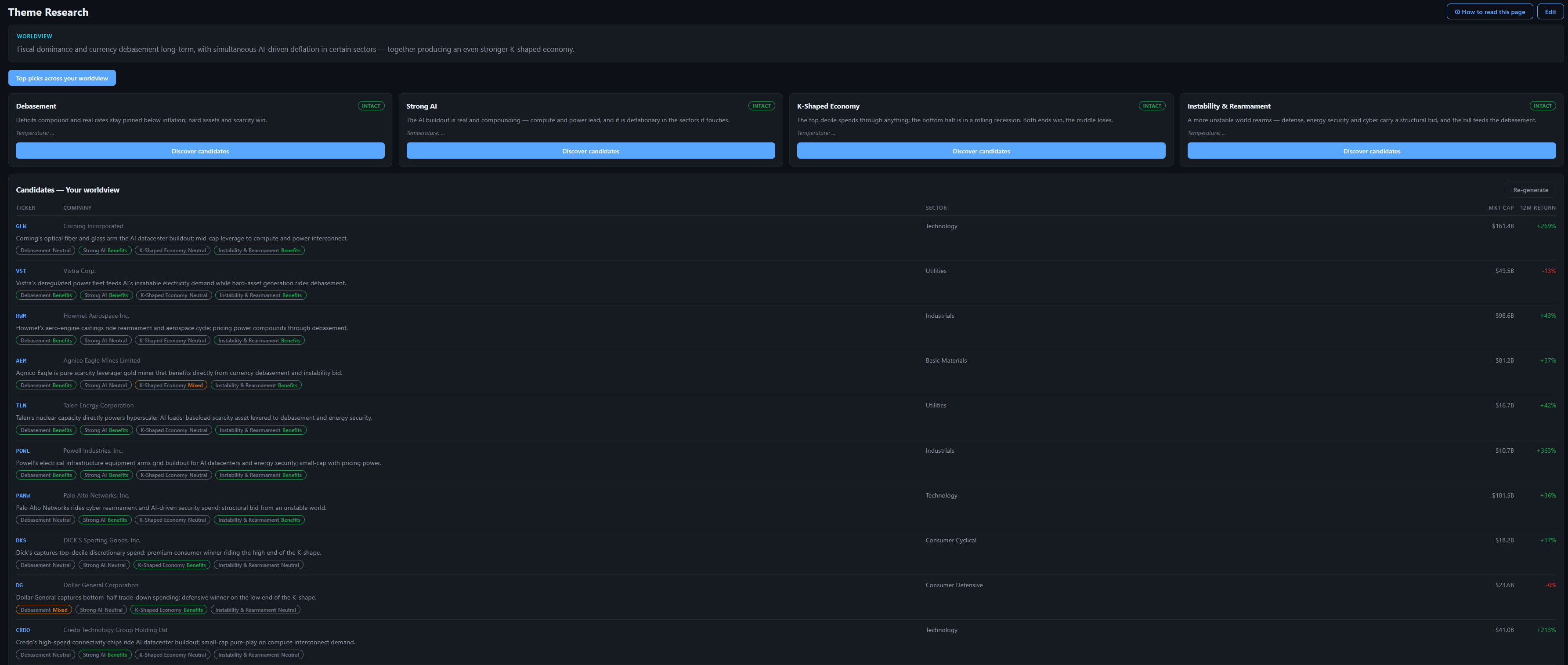
You tell it how you see the world — including how strongly you hold the debasement thesis — and it scores your actual holdings against it. Exposure bars show where you're positioned and where you're thin, so "I think the dollar's in trouble" becomes "here's the slice of my portfolio that actually expresses that, and here's the slice that doesn't."
Then Discover Candidates does the other half: it surfaces names that fit the thesis — with sector, size, and recent performance — so you're not staring at a blank page wondering what to add. You go from a worldview to a shortlist.
Run my own worldview through it — fiscal dominance and debasement long-term, alongside AI-driven deflation in the sectors it touches — and the debasement-positioned names that surface go well beyond the obvious gold play. Agnico Eagle (AEM) shows up as pure scarcity leverage, a miner that benefits directly from currency debasement. But so do Talen Energy (TLN) — nuclear baseload levered to both AI power demand and debasement — and Powell Industries (POWL), small-cap grid infrastructure with real pricing power. Each name carries a per-thesis verdict (Benefits / Neutral / Mixed), so you can see why it made the list, not just that it did.
See your own debasement score
It's free, no card, no ads, and your data stays private — EU-hosted, never sold. Import your DeGiro, Saxo, or any broker export, and you'll have your debasement exposure mapped in about a minute. Then you can decide whether the gap between what you believe and what you own is one worth closing.
StockDashes is for informational purposes only and is not financial advice. Themes like the debasement trade are narratives, not certainties — do your own research before acting on any of it.